Cold War paranoia aside, the future from the perspective of the late fifties was to be an optimistic place. A world of sleek, swooping contours and starlite neon, fishbowl helmets and jetpacks, lunar rovers, moving sidewalks, rocket-powered roller skates, and squelchy theremin-based pop tunes. Unfortunately, economics and politics have since forced us down a grimmer path to where our future likely has more in common with the charred bleakscapes of Blade Runner or Mad Max.
The TWA Flight Center, which opened in 1962 at the airport now called JFK, was the brainchild of Eero Saarinen, a Finnish-American architect who had designed not only the St Louis Gateway Arch, but also the iconic "tulip chair" as seen on the bridge of Star Trek's USS Enterprise. The Saarinen "Head House," as the main structure was called, was a prime example of what is considered Googie or Populuxe architecture, with its thin shell concrete roof, ceramic tiles, and curvilinear mezzanine. The sculptural contours were intended to suggest a soaring bird (though to me it looks more like a Cylon Raider). Predictably, it stirred up the ire of conservative critics of the era, while at the same time winning awards for its bold design. The terminal stayed in operation for four decades until TWA eventually hit the skids at century's end. Since then it has been shuttered to the public, largely, but not entirely, forgotten.
For a few hours on an autumnal Sunday, the good people of Open House New York arranged for the guard dogs to be chained up and the fence de-electrified. Charging down the red carpeted tube which connects the Flight Center to the functional area of the airport, I discovered an open realm of space age contours straight out of The Jetsons. I wasn't alone. The retrofuturist lobby swarmed with history buffs and photohounds, amateur and otherwise, eager to capture this rare sighting.
Technology has progressed at a dizzying pace since the Sixties. A list of devices and developments they couldn't possibly have conceived of then which we now take for granted could fill volumes. In small type with narrow margins. So why does it feel, when gazing around within a stunning time capsule such as this, that they knew something that we don't?
The Flight Center has been listed under the National Register of Historic Places, so fortunately it's not going anywhere soon (unlike the less fortunate UFO-shaped Pan Am Worldport, which lie in ruins as I AirTrained by). JetBlue, who now owns the building, is having it restored but isn't quite sure what to do with the space. Some suggestions bandied about include turning it into a conference center, aviation museum, or restaurant. I believe the current plan is to adapt it as part of a luxury hotel. Make it a tanning salon for all I care, just so long as they preserve this fleeting glimpse of The Tomorrow That Never Was.


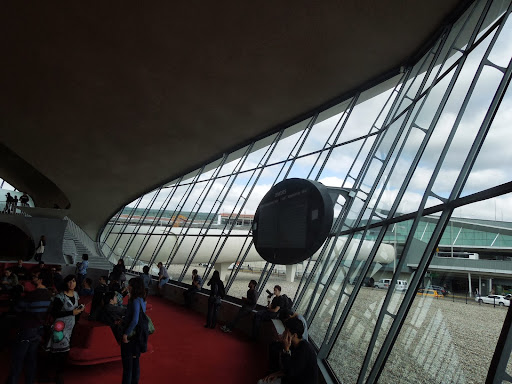


18 October 2013
TWA Flight Center

23 February 2013
The Old Apothecary Shoppe
Louis Dufilho Jr, whose name you'll likely recognize as America's first licensed pharmacist, opened an apothecary shop on New Orleans' Chartres Street in 1823. For nearly thirty years he led a solid and reputable business, if somewhat frighteningly primitive by today's perspective, as we shall soon see. Eventually the brick and stucco townhouse with wrought iron balconies was sold to Dr Joseph Dupas and under his watch developed a somewhat sinister reputation. It was rumored that people went in and were never seen to come out again. After Dupas died of syphilis, a wall of the shop collapsed and behind it were discovered the bones of numerous women. It turned out that, among other unsavory practices, Dupas had been conducting medical experiments on pregnant slaves, ones which his subjects often did not survive. As for the good doctor's sanity, he had been treating his syphilis with large doses of mercury, which could not have had beneficial results. His spirit is said to still haunt the premises, a stocky mustachioed figure in a brown suit and lab coat. Sensitive visitors report feeling nauseated and inexplicably sad. The building changed hands several times in his wake and was badly damaged by a 1915 hurricane. Finally, after being donated to the city by a philanthropist, it was opened in 1950 as the New Orleans Pharmacy Museum.
So what sorts of medical artifacts can the inquisitive visitor expect to find the shelves stocked with? Countless old bottles with faded labels indicating such contents as castor oil, chloroform, sarsaparilla, cod liver oil, and various tonics and mysterious elixirs. There are love potions, voodoo powders, a white ceramic leech jar, unsettling gynecological equipment, bonesaws, trephination drills, bullet extractors, urethral dialators, and a grisly-looking device called a tonsil guillotine. Opium was available over the counter until someone began paying attention to its addictive properties and the 1914 Harrison Tax Act was passed, curtailing the legal sale of narcotics.
Beside the entrance rests an old marble countered soda fountain. Medicine tended to taste so abysmal, especially back then, that apothecarists began mixing sodas and syrups as a chaser to disguise the unpleasant taste of their prescriptions. These sodas caught on with the public and soon perfectly healthy people began drifting in for a drink. In the display window is a showglobe, a multi-tiered bottle of colored water which was an early symbol of a pharmacy, much like a striped pole is to a barber shop. (Incidentally, if you're still thirsty for gruesome reading after this, might I suggest looking up what the red and white of the barber pole originally represented.)


Love potions were a legitimate medical commodity.


A 1855 soda fountain imported from Philadelphia.


A trephination drill to release evil spirits trapped within the skull.

Leeches were used to siphon off a patient's blood to keep the "humors" in balance.

Toothaches were a very popular ailment.

A tonsil guillotine.

A urethral dialator, no doubt a favorite among patients.

Cod liver oil, a 19th century child's worst nightmare.


Optical prosthetics.


22 February 2013
Lafayette Cemetery
Lafayette Cemetery is wedged amid the stately southern mansions of New Orleans' Garden District much like a splinter under a manicured fingernail. It lies across the street from the upscale and overpoweringly-blue Commander's Palace restaurant, separated by a decaying wall and a jaw-like iron gate. This City of the Dead was established in 1833, many of its first residents being victims of yellow fever, a popular disease in bayou country at the time. As with all cemeteries in New Orleans, burials are above ground in tombs or wall vaults or what are known as oven crypts due to their resemblance to bread ovens. Early attempts at earthly burial often resulted in bodies resurfacing after a heavy rainfall due to the city's notorious high water table.
Cult-spawning novelist Anne Rice, who once lived nearabouts, used Lafayette Cemetery as a location in several of her stories, such as the Mayfair witches' family tomb in The Witching Hour and vampire Lestat's crypt in Interview with a Vampire. Another notable resident, who this time was once actual flesh and blood, is Judge John Howard Ferguson of Plessy v Ferguson fame, the high profile court case that impeded civil rights for a good fifty years.
Vandalism and graverobbing were major problems during the twentieth century and extensive work has gone into restoration and preservation of the tombs by the organization Save Our Cemeteries. Guidebooks warn visitors not to venture into New Orleans' cemeteries alone due to potential muggings or, presumably, vampire attacks. But the Garden District is a classy section of town and difficult to imagine as a hotbed of violent crime. Plus, when I visited there were so many shuffling clusters of guided tours it was a challenge to keep them out of frame so as to make the cemetery appear suitably desolate and haunted in the photographs below. Enjoy.


