Showing posts with label museum. Show all posts

28 January 2012

Museum of the Moving Image

The Museum of the Moving Image can be found on an unassuming street in Astoria, Queens, hedged in by the tremendous Kaufman Astoria Studios complex. According to its website, the museum's mission is to advance the "public understanding and appreciation of the art, history, technique, and technology of film, television, and digital media." I stopped by on a rainy Friday afternoon to have my understanding of these things advanced.

The two current exhibits that grabbed my attention the firmest were Surviving Life: Collages by Jan Svankmajer and Jim Henson's Fantastic World. Svankmajer is a surrealist Czech puppeteer who blends the grotesque and the innocent into indescribable stop-motion films like Alice and Faust. Jim Henson, as we all know, was a Muppet.


This giant slab of building houses the Museum of the Moving Image.


A scene from Day the Earth Stood Still?


Just because you're paranoid doesn't mean they're not watching.


The following are scenes from the joyfully demented mind of Jan Svankmajer...


And now on to Hollywood...


Standard issue movie makeup.


From The Elephant Man.


"Na-Nu Na-Nu."


Rather convincing scale model of a theater.


As a kid you are told not to waste your time and money on foolish things like arcade games. As an adult you pay admission to visit them in museums.


The motherlode of Star Wars action figures.


My kingdom for a Hogan's Heroes lunchbox.


Film-related sheet music.


King Goshposh and Feathersto​ne from the Jim Henson exhibit, taken before I realized photographs were not permitted in the Muppet gallery. Unless you visit the museum yourself this is all you'll get.


An early Chaplin film viewed through a handcranked Mutoscope. You can't see it very well, but Chaplin is about to brain a mustachioed villain with a wooden mallet. Ha ha.


A Mutoscope of Melies' A Trip to the Moon, featuring the famous scene where the creampie moon gets a rocket lodged in its eye.


A Victorian-era zoetrope, an early device for producing the illusion of motion.


This Regan MacNeil mechanical puppet from The Exorcist is responsible for the revolving head effect.


Miniature of the Tyrell Skyscraper from Blade Runner.


An RCA television from 1939. World War II put a temporary halt on the development of television broadcasting, which didn't get kicking again until after the war ended.


A Sony Trinitron television with built-in Betamax video recorder from 1975.


16 January 2012

Louis Armstrong's House

Jazz legend Louis Armstrong and his fourth wife Lucille (a dancer he met at the Cotton Club) moved to Corona, Queens in 1943. There he lived for nearly thirty years, teaching the neighborhood kids to play trumpet and buying them ice cream. Lucille left the house to the city after her death, to be used as a museum. The garage where Louis kept his beloved Cadillac was turned into a giftshop and the basement game room into an exhibit hall. The rest of the three-story house was preserved as the Armstrongs had lived in it, filled with Chinese art and swinging retro-modern appliances. Many of the rooms feature built-in recordings of Louis speaking around his house. In one such recording, when asked about those upstart Beatles, Louis enthused "They're great! They've got a new beat there." In the upstairs den hangs a portrait of Louis painted by his friend Tony Bennett, affectionately signed "Benedetto."

Photography is not permitted on the residential floors (you can see photos of his kitchen at TheKitchn.com), but here's what I was otherwise able to get.


After his neighbors were evicted for nonpayment of rent, Louis had the house torn down and turned into this walled garden. The museum often puts on summer jazz concerts here.


The gold-plated Selmer trumpet given to Louis in 1933 by King George V of England.


"The property of Louis Armstrong."


Want more? Here's a great documentary of the man himself.


Satchmo.


10 December 2011

National Museum of the American Indian

On the cusp of Bowling Green in the financial district looms the National Museum of the American Indian, an imposing Beaux Arts backdrop behind many tourist photos of the Wall Street bull. Designed by renowned architect Cass Gilbert, the building was originally completed in 1907 as the Alexander Hamilton U.S. Custom House and operated under this guise until 1974. I was disappointed to learn this wasn't the same Custom House where Herman Melville battled corruption and Chester A. Arthur basked in it. (Prior to 1907 the Custom House was located in the Merchants Exchange at 55 Wall Street, though Melville apparently worked out of another office on Gansevoort Street.)

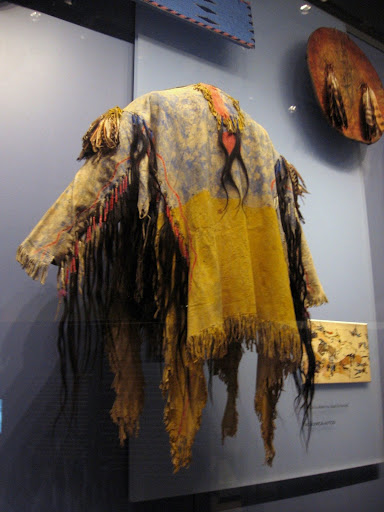
Security is airport-grade, due to the museum's status as a federal building. After clearing the metal detector without incident, I caught the tail of a guided tour on Native American clothing piloted by a member of the Hupa tribe. On display in the Infinity of Nations exhibit were a Hupa dance skirt outfitted with beads and thimbles, a Lakota war shirt possibly belonging to Crazy Horse, an Inuit parka made from caribou hide, and a disconcertingly out-of-place Victorian wedding dress worn by an advocate for Ponca tribal rights named Susette LaFlesche Tibbles, who went under the nickname Bright Eyes.

A second tour focused on the architecture of the building itself and granted me access to the locked chamber of the splendorous Collector's Office, these days often used as a movie location. An events planner had commandeered the stately Rotunda, but our group was able to slip along the perimeter to admire Reginald Marsh's series of seafaring murals and the marble columns of solid Vermont marble which flank each end.

On display in the contemporary gallery was an exhibit for the Ojibwe mixed-media artist and sculptor Carl Beam, in which ravens, stencils, and cultural iconography meet at the crossroads of the spiritual and political. Photography was forbidden in this gallery but examples of his work are available online.

I should mention admission to the museum is free, always a welcoming figure.


The National Museum of the American Indian.


Formerly the Alexander Hamilton U.S. Custom House (1907-1974).


The Custom House was designated a National Historic Landmark in 1976.


Entrance to the Infinity of Nations exhibit.


Tlingit spruce-root hat, ca 1900.


Nisga'a mask, British Columbia ca 1875.


Kwakwaka'wakw mechanical mask, ca 1900.


Nisga'a mechanical mask, ca 1870.


Alaskan Inupiaq parka, ca 1900.


This Lakota war shirt, decorated with human and horse hair, allegedly belonged to Crazy Horse.


Lakota square hand drum.


Aymara powder horn, ca 1910.


Kuna Kantule hat, ca 1924.


From a gallery of photographs of the Isleta Pueblo titled "Time Exposures."


The central Rotunda. The dome is, unsettlingly, made from concrete.


During World War II this skylight was tarred over, as was standard practice in event of an air raid.


Muralist Reginald Marsh deliberately obfuscated the name of this ship, the S.S. Normandie, after Joseph Kennedy protested the lack of America-centricity.


One of several solid Vermont marble columns.


Inside the Collector's Office.


Inaccessible to casual visitors, the Collector's Office is occasionally used as a movie set, most recently seen in Boardwalk Empire.


Glancing upwards from the base of the curved staircase.


A patriotic bald eagle newel.


"Future Clone" by Fritz Scholder, 1993.


Nautical ironwork ornaments the former Cashier's Office.


Pisces.