Sure, we've had some lousy stinkin' heads of state in recent years. But that doesn't mean their forebearers were loathed any less by their constituents. Take for example our 29th president, Warren G Harding. He was voted into office mainly because there was a bitter feud raging between the supporters of his rivals, and, not knowing anything about Harding, no one could think of a reason not to vote for him. Also, well, he kinda looked like a president. Toss in a couple of scandals, extramarital affairs, and a bumbling grasp of language, and you've got the fixin's for one big failure of a figurehead.
The ever-tactful HL Mencken put it delicately: "He writes the worst English that I have ever encountered. It reminds me of a string of wet sponges; it reminds me of tattered washing on the line; it reminds me of stale bean soup, of college yells, of dogs barking idiotically through endless nights. It is so bad that a sort of grandeur creeps into it. It drags itself out of the dark abysm of pish, and crawls insanely up the topmost pinnacle of posh. It is rumble and bumble. It is flap and doodle. It is balder and dash."
Later, the poet e.e. cummings elegized him as "the only man, woman or child who wrote a simple declarative sentence with seven grammatical errors." Even Harding himself got in a few jabs, once musing "I am not fit for this office and never should have been here."
At least he was honest about it.
24 October 2007
Flap and Doodle

24 May 2007
Yosemite Sam Don't Give a Death Valley Damn
"When you get to the top of a mountain, keep climbing." - Zen proverb
We lost cell phone reception shortly after entering Death Valley. The dashboard thermometer gave a reading of 96 degrees Fahrenheit, and it was early yet. A steep, winding road through the Black Mountains took us 5,500 feet up to Dante's View overlooking the Badwater basin, which at 282 feet below sea-level is the lowest surface point in North America. What looked like mystical stretches of lakewater was in fact salt deposit. From here we could look down on birds in flight. Amid the arid desert soil grew one solitary purple flower.
When we told the ranger at the Death Valley Visitor Center we intended to visit the dunes, he puffed out his cheeks and replied "Ooo, it's going to be hot out there." In fact venturing onto the desert dunes was literally like standing next to an open oven cranked to full blast. It was easily 105 degrees and the sand was blistering. Tracks were routinely swept away by the wind, and it was easy to envision yourself as last man on earth in some apocalyptic deathscape.
Speaking of which, northwest of Death Valley lies the Manzanar Internment Camp where the Japanese were rounded up during WWII. Nothing really left of it but a guard house and a memorial sign with Nazi-esque lettering. The word manzanar, incidentally, translates from Spanish as "apple orchard."
We passed near Mount Whitney, tallest mountain in the United States, though had to guess which one it was. When you're driving alongside a mountain range, all of the peaks look pretty damn tall. When you hear something is the tallest whatever, you expect it to stand alone, towering mightily over its peers. But in a mountain range the designated "tallest" might be in the lead by only a few meters. Less impressive somehow. An intervehicular dispute was sparked over what constituted a "sawtooth peak."
You can't venture any significant distance in Yosemite without hitting a majestic rock formation or waterfall. The landmarks are plentiful - Cathedral Rock, Bridalveil Falls, the oft-scaled El Captian with the heart-shaped cleft in its side, the Half Dome, Glacier Point. We hiked up to Sentinel Dome, elevation 8,122 feet, arriving at the peak just as dusk was setting in, which made for some dramatic photography. Attempting to capture on film a panoramic view such as the Sentinel Dome provides is frustrating. The camera lens simply cannot see what the eye can. Imagine watching Lawrence of Arabia on pan-and-scan, where the sweeping deserts become little more than a sandbox.
Night had fallen by the time we returned to the car. No deer jumped out in front of us on our way down the precarious mountainside road, but we did spot a white wolf prowling the roadside. A billboard notice at our campground warned of a mountain lion which had been spotted in the park earlier in the week. I lay in my tent well into the night wondering whether it would be a bear, a wolf, or a mountain lion which finally would get me as I slept. The night-time temperature dropped as low as 35 degrees.

The second day we set out early on a sixteen mile hike (eight miles each way) to the top of the notorious Half Dome. The first four miles were mostly vertical ones, making demands on muscles that are seldom called upon in citylife. Jagged rocks slick with spray formed steps up the side of the roaring cascade. Sometimes there was a guard rail, sometimes not. When we reached the top of the falls we looked down at an elegant rainbow spanning the gorge.
There were noticeably less people around during the second four miles. Anyone beyond this point was in it for the long haul. At a junction we stopped for a lunch of crackers and cheese and dried mango. We achingly reached the final ascent where the air was growing noticeably thinner. Snaggletoothed stone steps were cut in the sheer face of the mountain, waggling erratically to the crest. Glancing down was a bad idea. At an elevation of 8,800 feet, one misplaced footing would be a fatal mistake. I don't know about fear of heights, but let's just say I have a healthy respect for them. Unbelievably, at the top of the steps there was farther to go. Steel cables allowed the insane to hoist themselves up the vertical face of the rock to the absolute top of the Half Dome. A mad German in goggles, running shorts, and no supplies whatsoever who had breezed past us on the trail earlier pulled himself effortlessly up to the top of the world. The week before, a woman had lost her grip on the cables and fallen a thousand feet to her death.
I came down the mountain with eyes trained directly on the steps ahead, making a concentrated effort to block out all peripheral vision. The endless eight miles back to civilization were murder on my legs. Every step was a searing poker driven through my heel and deep into my calf. The first eight miles had been almost entirely uphill, which meant the way back was nearly all down. When your legs are screaming in pain, downhill is nearly as bad as up, because you land heavily with each step on the very same muscles you wore out on the way up. Not to mention you have to watch your footing on the littered fragments of rock to avoid fracturing an ankle. That night we collapsed into sleep the instant heads connected with pillows.
The next day began with a drive down to the Sequoias to see the General Sherman Tree, which is billed as the largest tree in the world, in terms of mass. Didn't seem particularly impressive to me, and I was skeptical that every tree on the planet has been properly cataloged to allow such a bold statement. Climbed to a 6,700-foot vista called Moro Rock to look out over the entire universe. This time there were plenty of secure guard rails. We intended to visit the Crystal Cave but missed the last tour by half an hour.
Outside of Lancaster in the Mojave Desert we located the Antelope Valley Poppy Reserve. Unfortunately it must have been a bad season, for the place was deserted and there was nary a poppy in sight. Lancaster is probably best known as the home of the Edwards Air Force Base and SpaceShipOne, but to me the town has more significance as the place where Frank Zappa and Captain Beefheart met. It's pretty obvious how much the Mojave Desert inspired much of the dusty Americana of Beefheart's lyrics.
Wind powered turbines lined the hills on either side of the road leading to Los Angeles. Soon we became ensnared in urban freeway traffic and left the hinterlands behind.
02 May 2007
The Prison Ship Martyrs Monument
Somehow, in all my various NYC wanderings, I'd managed to miss the Fort Greene neighborhood, with its ivy-clung brownstones and gothic churches. While making amends for this oversight, I was attracted to the strange obelisk capping the crest of Fort Greene Park. Currently it is veiled in restorative scaffolding and its base fenced off, which meant I failed to get close enough for a peek at any potential historical marker that would explain its purpose. Instead I had to wait until I returned home for some cursory internet research to find out what it was all about.
During the Revolutionary War, the British seized New York in the wake of the Battle of Long Island. They quickly rounded up anyone who refused to swear allegiance to the Crown of England or join the King's Navy, and imprisoned them on derelict ships anchored in Wallabout Bay (located between the Manhattan and Williamsburg bridges of today). The most notorious of these prison ships was the Old Jersey, rechristened "Hell" by its unfortunate inhabitants. Between 1776 and 1783, disease, starvation, and neglect led to the death of over eleven thousand of these soldiers, sailors, women, and children. The corpses were buried in shallow graves in the bay or merely dumped overboard. In the following years, bleached bones regularly washed up onto the Brooklyn shore and were respectfully collected. The land which is now Fort Greene Park was transformed from the site of an old fort into Brooklyn's first park in 1847, thanks in part to the vocal efforts of the editor of the Brooklyn Daily Eagle - a fellow by the name of Walt Whitman. Tammany Society funded a monument for the dead in the 1880s near what is now the Brooklyn Navy Yard waterfront. In 1867 Frederick Law Olmsted and Calvert Vaux (of Central Park fame) were commissioned to spruce up the thirty acres of park. A granite crypt was built to hold the remains of the prison ship martyrs.
The 148-foot Doric column which now towers above the plaza on the hill was designed by the architectural firm of McKim, Meade, and White in 1908. A staircase, now closed to the public, led to the observation deck which housed a lighted urn which could be seen for miles around. The urn was created by Adolph Alexander Weinman, as were four bronze eagles which were later removed in the wake of repeated vandalism. The eagles are expected to be returned following the current renovation.
The memorial's motto - "They Shall Not Be Forgotten."
On a side note, before being renamed after Nathanael Greene following the War of 1812, the fort which topped the hill was known as Fort Putnam, build by and named after Colonial Rufus Putnam, nephew of General Israel "Don't fire 'til you see the whites of their eyes" Putnam. Who just happens to occupy a branch on my family tree.
29 April 2007
Tools o' the Trade
The Guardian Unlimited has an ongoing section called Writers' Rooms which features photographs of various writers' workspaces. Will Self, AS Byatt, Sarah Waters, and a dozen or so others have been showcased so far. There is something strangely fascinating about an artist's studio - the environment in which a work is given life. Matter of fact I generally would rather see a photo of an artist's workspace than of the artist himself.
There was a collection of photography that came out in the eighties called The Faces of Science Fiction which depicted numerous notable SF writers, often at their desks. Flipping through the pages, I found it was always the arrangement of desk, chair, window with view, cluttered bookshelves, wall hangings, etc, that caught my eye, much more so than the likeness of the author. And I would then entertain thoughts of what I would rearrange were it my own space. I suppose a portion of the fantasy of becoming a writer is having some territory of your own in which to do your scribbling - the romance of Raskolnikov's dusty attic garret and all that. Possibly a version of the same drive for identity that makes high school kids decorate their lockers or draw heavy metal band logos inside their algebra textbooks.
JG Ballard's workspace features an old desk containing a portable manual typewriter. In the accompanying blurb he mentions that he writes mostly in longhand. He then goes on to make a rather idiotic assertion: "I have resisted getting a computer because I distrust the whole PC thing. I don't think a great book has yet been written on computer."
The reason this makes me flinch is because it attributes the value of art to its tools. A writer captures the ideas pouring out of the brain. What difference does it make whether those ideas are recorded with computer, typewriter, fountain pen, dictation, quill, bloody finger, or chisel and clay tablet? If Ballard finds writing by pen the most effective for his craft, more power to him. But to suggest others must follow suit is a little too Stalinist for comfort. Might as well claim no good poetry can be written lefthanded.
I'll wager that following the invention of the typewriter, a few squinty crustaceans grumbled that no great book could be written on one of those either.
22 April 2007
Pull My Daisy
This weekend Tip My Cup Productions put on a 24 hour theater festival under the moniker of The First Annual Tip My Cup Quickie. What typically happens at these things is a collective of playwrights are given some specifics based on a predetermined theme and sent to their respective corners to come up with an erudite script within a few frenzied hours. This they pass off to their assembled squad of actors who sleeplessly rehearse during the morning and afternoon, and, with any luck, have the thing polished and perfected in time to perform it during the evening in front of a paying audience armed with fruit in varying stages of decay.
Playwright kamikaze Sean Michael Welch decided to get involved in the project for reasons known only to himself. He was given the topic of a Craigslist Missed Connection with the heading "I accidentally spilled my grandmother's ashes on you." He was also given two able-bodied actors to work with. However, finding comedy often works best in threes, he somewhat foolhardily wound up, once the script was completed, making a call to the actors to inform them, "I'm going to have to come in for rehearsal with you. I've written myself into the script."
The festival was held in an upstairs backroom at a yupperific gay bar in the West Village. There was a two-drink minimum which was rather, er, enthusiastically enforced. The audience seemed already well-lubricated before the show began and there was nary an empty stool in the house.
Count on alcohol to make things funnier, but these were pretty funny to begin with. The plays all went over well, and laughter and applause mostly drowned out the electronic hoedown music issuing up the stairs. There were four pieces in total at the session I attended - the other three concerned a haunted toaster, a turtle enthusiast with a darker side, and two glamorstruck roommates with a bit too much interest invested in the life of Angelina Jolie.
Sean's contribution, entitled A Very Bad Play, has been posted on his website for the enjoyment of all. Feel free.
18 April 2007
Bring Out Your Dead
I've been keeping a line on the various cultural landmarks that have come crashing down since I landed in the Big Onion. The list is growing unfavorably long.
As everyone knows, CBGB bit the dust last autumn.
Coliseum Books shut down, reopened in a new location, and shut down once again.
The building which once housed McGurk's Suicide Hall was torn down to make way for a condominium.
Cedar Tavern has been closed for renovation for many months. Some are skeptical they'll ever reopen.
Onetime speakeasy Chumley's is closed indefinitely after a chimney collapsed. It has been speculated that the building will have to be razed.
Tower Records is gone, but I'm not particularly concerned about that. What'd they ever do for me?
Former Beat Generation haunt West End Café was rechristened Havana Central. I haven't been there since the reopening, so I don't know if they've retained the literary memorabilia on the walls.
Not sure what's going on over at the legendary Gotham Book Mart. The last two occasions I passed by, its gates were locked, windows dark, and a foreboding sign on the door stated simply "on vacation." The whole scene feels uneasily like the aftermath of a mob hit.
And now Tonic, one of my favorite venues for adventurous music, couldn't handle the increase in rent and was forced to take a powder. Marc Ribot, Beat Circus, Elysian Fields, and others will have to find a new home.
Unsettling trend. Who's next, I wonder.
16 April 2007
Pennies From Heaven
"An old lady on Main Street last night picked up a shoe. The shoe had a foot in it. We're gonna make you pay for that mess." - Orson Welles, Touch of Evil
When a disembodied leg lands nearby on the sidewalk, one of your first inclinations might be to glance skywards as though expecting rain and wonder "where's the rest?" In the case of the hapless lawyer who recently swandived off the Empire State Building, the rest in question was found on a 30th floor parapet. The building tapers, you see.
I thought I'd once read somewhere that the observation deck was suicide-proof, in the form of an outcropping ledge below that would "catch" suicide attempts. This may be false information, since a hasty web search returned no results. Either way, our leaping lawyer defied any such precautions by exiting via an office window on the 69th floor. It seems he was in conference with a client moments before. "Pardon me while I step out for a smoke…"
At least one tourist was spotted snapping a picture of the argyle-clad appendage. Another memento for the photo album, filed next to the Naked Cowboy.
Tourist spot bedamned, the Empire is one of my favorite architectural structures in New York. Standing below, from across the street on 34th, gazing up at the sheer size of the art deco obelisk can be daunting - the amount of knowledge, skill, and utter fearlessness that went into the thing. And knowing the speed at which it was constructed - a floor a day at times, within a mere eighteen months from start to finish, rising brazenly into the stratosphere during the depths of the Great Depression, with the intent on claiming the title of tallest building in the world, and with a freakin' zeppelin docking station of all things at the crown - is more than a little impressive. A testament to what humanity is capable of. And let's not forget Kong.
If you're going to pick a building to dive off, honestly, you could do worse. Still, I feel bad for the patrons of Cafe Europa who had their lunch unforeseeably disrupted.
12 April 2007
Metaphysical Warning Stickers
Evidently someone aboard the Brooklyn-bound subway train was feeling creative recently. Not to mention a touch dispirited.

Let's hope everything works out well for them in the long run.
11 April 2007
So It Goes
Kurt Vonnegut's eight rules for writing a short story, culled from Bagombo Snuff Box - Uncollected Short Fiction:
1. Use the time of a total stranger in such a way that he or she will not feel the time was wasted.
2. Give the reader at least one character he or she can root for.
3. Every character should want something, even if it is only a glass of water.
4. Every sentence must do one of two things - reveal character or advance the action.
5. Start as close to the end as possible.
6. Be a sadist. No matter how sweet and innocent your leading characters, make awful things happen to them - in order that the reader may see what they are made of.
7. Write to please just one person. If you open a window and make love to the world, so to speak, your story will get pneumonia.
8. Give your readers as much information as possible as soon as possible. To heck with suspense. Readers should have such complete understanding of what is going on, where and why, that they could finish the story themselves, should cockroaches eat the last few pages.
04 April 2007
Jumping Someone Else's Train
Police investigation in the Rockefeller Center subway station yesterday. The uptown F and V trains slowed to a crawl, diverted to other tracks for a stretch. As my train pulled through Rockefeller, I spotted yellow police tape blocking off an area of the platform and officers interrogating witnesses. But witnesses to what? A backlog of commuters squeezed into the train as the doors opened and it was difficult to make any sense of the doings in the station. When I reached home that evening I did some pointed googling but was unable to find any mention of the incident. Finally this afternoon the New York Post reported a (supposed) homeless man had jumped in front of the oncoming V train. Fortunately (or un-, depending on his intent) he landed in the trough and the train passed over him, leaving him relatively uninjured. Reportedly his parting word before the jump, addressed to a nearby woman, was a curt "bye."
Not sure why there was so little information on this in Internetland. When something irregular happens such as this, oughtn't there be somewhere you can look for the skinny? I recall walking past the Harvard Station in Cambridge one time several years ago and finding it swarming with firemen, the square clogged with fire engines and commotion. Obviously something noteworthy was going on, but there was no news whatsoever of it in any of the Boston papers or any websites that I could find. If something like that is going unreported, presumably to avoid alarming the public, it makes me question what else is being hushed up.
17 December 2006
But What Happened to the Partridge?
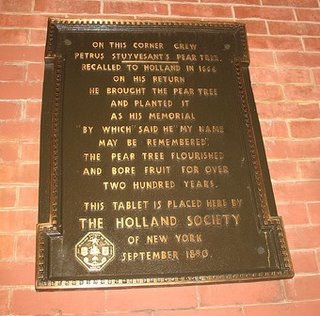
There are a slew of historical landmarks in Manhattan, commemorating everything from presidents to punks. But one of my favorites has to be the plaque that signifies "Pear Tree Corner" on an unassuming little streetcorner on the Lower East Side.
In 1647, former New Amsterdam governor Peter Stuyvesant (sometimes known as "Pegleg Pete" after losing a leg in a sea battle with Spain over the island of Saint Martin) returned from a voyage to Holland with, of all things, a pear tree in his cargo. He affectionately planted this tree on his 62-acre estate, at what is now the northeast corner of East 13th Street and Third Avenue. The tree was fruitful for over two centuries as the landscape around it gradually transformed from farmland to city block, until one fateful day in 1857 when a horrendous horse-drawn carriage pile-up effectively sent it to that Great Garden in the sky.
By that time a small apothecary had opened on the corner, supplying medicinal herbs to the inhabitants of what was coming to be called the Lower East Side. Over the years the Brunswick Apotheke, as it was once called, evolved into Kiehl's Pharmacy.
In 1890, in an effort to preserve the memory of Dutch presence in Manhattan, the Holland Society affixed a plaque to the wall of the pharmacy, marking the spot where the tree had stood. Unfortunately the building fell into disrepair over the years, and in 1958 Kiehl's Pharmacy relocated up the street to more modern digs. The original building was slated for demolition and the plaque wound up at St Mark's Church in-the-Bowery, where Stuyvesant had been interred, since no one else seemed to want it.
But the story doesn't end there. A half-century later, with a sudden rekindling of interest in its roots, Kiehl's returned to its original, newly renovated location at Pear Tree Corner and promptly demanded the now quite weatherbeaten plaque be restored. Following a brief proprietary tug-of-war, mark and marker have now been reunited. See for yourself.
14 December 2006
Pirates of Pynchon
I finally nabbed a copy of the new Pynchon novel. The man is pretty high up on my list of favorite writers ever (mostly due to the luminous Gravity's Rainbow), so I've been looking forward to plowing through the new one ever since reading Pynchon's very own penned blurb from Amazon. The Gilded Age, anarchists, World's Columbian Exposition, Nikola Tesla, Groucho Marx - all gathered in one Herculean tome. What's not to like?
I've noticed that nearly all the book reviews refer to the supposed "difficulty" of Pynchon's prose and the need to "decode" the text. Am I missing something here? Granted, Mason & Dixon was difficult to pick up, mostly due to the antiquated syntax (and physical weight). But Crying of Lot 49 and Vineland were not what I would term difficult reading. Even Gravity's Rainbow, which is pretty thematically challenging, is nowhere near on a par with, say, Finnegans Wake. So far in Against the Day I've encountered a boy's adventure yarn, a pulp detective story, a western, and a bit of Jules Verne-esque flight of fancy. Pynchon is a pretty smart fellow and his references are far and wide, but it's not all that different from when Family Guy references a scene from, say, mid-seventies Electric Company. Pynchon brings in events like the Michelson-Morley experiment with aether, which I vaguely remembered from a history class long ago. Things like that should not be so obscure as to stump book reviewers. Maybe the problem lies more in our standards of education. [Or more likely book reviewers don't want to spend the time on a 1,100 page novel when there's more cash involved in chugging through four 400 pagers.] Sure, there are plenty of mysteries to unravel for the unraveling-inclined, but it's also just a ripping good yarn. Reading Pynchon, to me, is reminiscent of teaching Einstein through Road Runner cartoons. A highly educational slapstick chase sequence. And how anyone could not relish a romp through Pynchon's universe is beyond me.
Then you have those who blame him for being large in scope. The canvas of his novels is a sprawling widescreen epic - that's what he does. It's a bit like blaming Bosch's Garden of Earthly Delights for not being Van Gogh's Sunflower. Many reviewers complain that they wish Against the Day had been smaller and the storyline more concise. Again, like griping that Bosch's canvas is too busy and he should have concentrated on only a few of the figures. Finding fault with Pynchon for not being Agatha Christie is just irrelevant. And faulting ambition is just bad all round.
I tried reading Vineland and couldn't get into it for a number of reasons. But at least I took the book on its own terms instead of accusing it of not being a cookbook.
Anyhow, there's an Against the Day group read going on over at The Chumps of Choice, spearheaded by the esteemed Neddie Jingo. Worth investigating.
27 October 2006
"Someone must have been telling lies about Joseph K..."
Apparently, due to Homeland Security policy, if you lose your wallet containing all your identification in New York & then head over to the DMV for a replacement ID you'll be told they can't help you without a social security card. Meanwhile at the social security office they'll inform you they can't do anything for you unless you have a valid photo ID. Yes, this did happen to an acquaintance of mine, & yes, he is caught in this predicament, & no, the automatons behind the counters at both offices do not seem to recognize the ludicrousness of the situation as they send him back & forth with straight faces.
Ha ha... ha.
26 October 2006
On Location
Walking around the Village yesterday evening I ran into a film crew on practically every third block. There were crews assembling equipment on Hudson Street, MacDougal north of Bleecker, in Washington Square Park, & north of Tompkins Square. Whether these were individual film shoots or one big one, I couldn't tell. Maybe there's another Spiderman flick in the works.
Then I stopped in a bar called Hi Fi where a Dukes of Stratosphear album was spinning on the jukebox. When that ended it was replaced by something by Husker Du. The beer was two for the price of one.
A strange thing about New York is you can buy a brand new CD from Circuit City for less than a previously owned version from a used record store. I'm no economics whiz, but it seems like that sort of setup wouldn't last very long.
And finally, this new Firefox spellchecker is kinda nifty.
18 October 2006
How to Be a Villain
Evil Laughs, Secret Lairs, Master Plans, and More!!!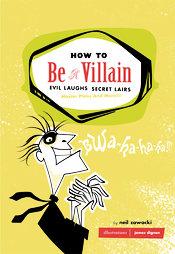 Book Description
A delightfully evil gift, How to Be a Villain is a step-by-step guide to joining the forces of darkness. Because, though villains may never win, they sure have more fun, hatching master plans for world domination, smoothing their dastardly tights. Neil Zawacki answers all the most urgent questions: Should I go with a black or red theme? Do I invest in an army of winged monkeys or ninja warriors? And just where will I put the evil hideout? Whether readers choose to pursue a career as a Criminal Mastermind, Mad Scientist, Corporate Bastard, or just a Wanna-be Evil Genius, they are sure to find plenty of tips for jumpstarting any evil enterprise. Cheaper than attending the annual bad guy conference and way more fun than being good, How to Be a Villain is guaranteed to elicit deep-throated evil laughs across the land.
About the Author
Neil Zawacki is a California-based freelance writer who has long been interested in the plight of evil-doers. Generally considered to be quite villainous himself, he enjoys theater, literature, and world domination. James Dignan 's drawings have appeared in the New Yorker, the Wall Street Journal and magazines such as Vogue, Elle, and Marie Claire. He divides his evil-doing time between Australia and Europe.
[From Amazon]
16 October 2006
Country, BlueGrass, and Blues (1973-2006)
Patti Smith led the final show at CBGB Sunday night, alongside Lenny Kaye, Flea, and Richard Lloyd. They performed a slew of vintage songs from the club's infamous past by the likes of Television, Blondie, the Dead Boys, the Ramones, & of course Smith herself.
I wasn't there for all of that, but did stop in the day before for one last look before another cultural landmark bit the dust. I don't understand how this sort of thing happens so often. Over rent, of course. It's usually about money. Imagine the rent on the Lincoln Memorial being raised impossibly high, forcing it to be shut down & turned into a Rite-Aid. Evidently no one along the line was willing to cut owner Hilly Kristal a break. He was unsuccessful in getting the club acknowledged as a historical landmark, despite the fact that the streetcorner up the block is celebrated in signage as Joey Ramone Place.
Still, those who refuse to mourn extensively have the right idea. If you cling to physical manifestations instead of the spirit which inhabited them you end up with fundamentalism. So it goes.


11 October 2006
Plane Plane Against the Grain
I was sitting beside the open window of my Brooklyn apartment, a book sprawled across my lap, listening to the whistling breeze, the distant tinkle of an ice cream van, mothers picking their kids up from the school on the next block. The phone chirped. It was a friend from Boston asking if I was okay. Of course, why? Because it seems a plane had crashed into a building on the Upper East Side. I went up to the roof to glance Manhattan-wards to see what I could see, but I couldn't even spot the Empire State Building through the rainy haze that was settling over the city. Everything seemed so peaceful that it felt very isolating. For all I knew the entire island of Manhattan could be burning and it would take someone from Boston who had seen it on the news to inform me of it.
08 October 2006
A Pigfoot and a Bottle of Beer
Last night The Moonlighters played one of the more intimate venues to see bands in Brooklyn — Barbes in Park Slope. Despite late night subway tomfoolery, I was able to catch the show. The Moonlighters' instrumentation is comprised of ukulele, guitar, slide steel guitar, and upright bass. Notably missing are any sign of drums, a point of which they are proud. Vocals are handled by Bliss Blood and Carla Murray. They specialize in covers of semi-obscure blues/jazz from the twenties and thirties, and originals which could be forgivably mistaken for stemming from that period as well.
They swing, they cook, they jive. Mike Neer is a monster on slide guitar, always melodic while darting in and out of the hectic rhythms. I don't think I heard him flub a single note. Bliss and Carla's voices meld together into a perfect velvety conspiracy. And Carla has great taste in hatwear.
Among their covers were a Bessie Smith tune, the standard "Moanin' Low," a few hobo tunes, and a racy number called "Hold Your Man" from the pre-Hays Code Gable-Harlow flick of the same name. They are able to smirk gently at the more antiquated views contained in some of the material they cover while reveling in its inherent joy. Great band.
20 September 2006
When Constabulary Duty's To Be Done
There were a gaggle of police carousing around 53rd street this afternoon. They were stationed on every corner, directing traffic and harassing pushcart vendors. There were clusters in a plaza practicing some sort of drill. Down in the subway entrances a squad stood around imposingly beside an aggressive sign warning that bags were liable to be searched. As suspicious as I must have looked, I somehow made it past without my rucksack being violated.
I've no idea what was going on that required so much security. The Ford Motor Company were having some sort of shindig at a nearby hotel. MoMA had more barriers out front than usual. But this looked like a pretty large scale event — as if the Archduke Ferdinand was passing though town and trouble was expected.
The other day there was a parade of what might have been Shiners bearing a mannequin pope on a litter along Houston Street. They were trailed by a full-out marching band in matching t-shirts. Bringing up the rear, much like a caboose, was one of those squat white police buggies.
Maybe the two incidents are related.
18 September 2006
War Prigs
Being in the midst of a history binge right now, I'm gradually reminded of the fact that, until fairly recently, nations treated warfare as general entertainment. The armies of Napoleon? What was their motivation for repeatedly attacking Russia and England other than it was something to do? The Spanish-American War seems to have fulfilled for the United States the same function as a good football rally. It's as though conquering territory was just a way to pass an afternoon. Also there was a masculinity factor—you just weren't a man until you'd stuck a bayonet through someone's face.
The First World War is the first example of Americans responding with "eh, let's keep out of this, shall we?" How Wilson eventually suckered the country into it I don't know, since we didn't stand to gain much by entering the fray. Yes, Germany was habitually firing torpedoes at our ships, but there were other ways around that than committing soldiers. Isolationism was again the predominant outlook in the early days of the Second World War, which all changed when the Pearl Harbor attack gave the public a thirst for revenge.
Since then the general attitude has been, if not pacifism, then at least a strong reluctance towards military involvement. Not by warhawk leaders, of course, but by the commonfolk. The ones who actually have to do the fighting. Seems to me that the introduction of radio and later television sapped a lot of the energy that once was expelled via warfare. As a culture we demand our movies and teevee shows chock full of violence. And, honestly, who in America doesn't enjoy a good twofisted bar brawl? Watch any two drunken buffed-up meatheads bump torsos on a Saturday night. Face it, we're a violent people on an individual level. But for some reason when we get into an international skirmish, young redblooded males aren't rushing the recruiting offices with the same vigor as they did during the Civil War. I'd like to think this indicates some form of moral evolution, but the pessimist in me suspects elsewise.
13 September 2006
Burma Shave
In the mid 1920s, the American Safety Razor Company began posting sequential road signs all along the pre-interstate two lane roads advertising their Burma Shave shaving cream. The distinctive signs were red with white lettering, spaced about a hundred feet apart. Each contained a line of a humorous verse, while the last sign sported the Burma Shave slogan as punctuation. By the sixties these signs were being devoured by the colossal billboards so familiar to roadgoers today. The last Burma Shave sign was taken down in 1963.
Spring has sprung
The grass has riz
Where last year's
Careless drivers is
Burma Shave
Cautious rider
To her reckless dear
Let's have less bull
And lots more steer
Burma Shave
Unless your face
Is stinger free
You'd better let
Your honey be
Burma Shave
Proper distance
To him was bunk
They pulled him out
Of some guy's trunk
Burma Shave
A beard that's rough
And overgrown
Is better than
A chaperone
Burma Shave
The hobo lets
His whiskers sprout
It's trains—not girls
That he takes out
Burma Shave
We can't provide you
With a date
But we do supply
The best darn bait
Burma Shave
Heaven's latest
Neophyte
Signaled left
Then turned right
Burma Shave
To steal a kiss
He had the knack
But lacked the cheek
To get one back
Burma Shave
Why is it when
You try to pass
The guy in front
Goes twice as fast?
Burma Shave
She put a bullet
Thru his hat
But he's had
Closer shaves than that
Burma Shave
We're widely read
And often quoted
But it's shaves not signs
For which we're noted
Burma Shave
Around the curve
Lickety-split
Beautiful car
Wasn't it?
Burma Shave
Our fortune is
Your shaven face
It's our best
Advertising space
Burma Shave
If Crusoe'd kept
His chin more tidy
He might have found
A lady Friday
Burma Shave
The bearded devil
Is forced to dwell
In the only place
Where they don't sell
Burma Shave
"No, no," she said
To her bristly beau
"I'd rather
Eat the mistletoe"
Burma Shave
These signs are not
For laughs alone
The face they save
May be your own
Burma Shave
The hero was brave
And strong and willin'
She felt his chin—
Then wed the villain
Burma Shave
At intersections
Look each way
A harp sounds nice
But it's hard to play
Burma Shave
Car in ditch
Driver in tree
The moon was full
And so was he
Burma Shave
Passing school zone
Take it slow
Let our little
Shavers grow
Burma Shave
A peach looks good
With lots of fuzz
But man's no peach
And never was
Burma Shave
Don't take a curve
At 60 per
We hate to lose
A customer
Burma Shave
Don't lose your head
To gain a minute
You need your head
Your brains are in it
Burma Shave
Violets are blue
Roses are pink
On graves of those
Who drive and drink
Burma Shave
My job is keeping
Faces clean
And nobody knows
De stubble I've seen
Burma Shave
He tried to cross
As fast train neared
Death didn't draft him
He volunteered
Burma Shave
Although insured
Remember, kiddo
They don't pay you
They pay your widow
Burma Shave
If you don't know
Whose signs these are
You haven't driven
Very far

10 September 2006
The Man Who Was Thursday
"Are you the new recruit?" asked the invisible chief, who seemed to have heard all about it. "All right. You are engaged."
Syme, quite swept off his feet, made a feeble fight against this irrevocable phrase.
"I really have no experience," he began.
"No one has any experience," said the other, "of the battle of Armageddon."
"But I am really unfit —"
"You are willing, that is enough," said the unknown.
"Well, really," said Syme. "I don't know any profession of which mere willingness is the final test."
"I do," said the other — "martyrs. I am condemning you to death. Good day."
07 September 2006
Honk
Whenever I find myself in midtown Madhattan, circumnavigating uncertain tourists on my way from the subway station to the library and back, the deadpan voice of Jim Jarmusch in Fishing With John repeatedly springs to mind: "Why am I here?"
31 August 2006
The Beat Circus
The Fantastical Beat Circus show at Tonic, on the Lower East Side. Openers were the Circus' sibling band Alec & the Eyesores, followed by Brian Dewan, whose presence reminded me of David Lynch's eccentric sincerity. He ambled onstage dressed in khaki shorts and a green tie. Ordinarily he accompanies himself on electric zither but it had broken in transit, so tonight he backed his folk Americana on accordion & an electrified autoharp that was grafted onto an aluminum walker. He opened with "Kill For Peace" by the Fugs. Another of his tunes was about the invention of a robotic prosthetic appendage called "The Boston Arm." He finished his set with an enthusiastic medley of children's singalongs & playground taunts.
Now then, the mighty mighty Beat Circus. As usual they were joined by a few musical guests, notably Curtis Hasselbring from Golem on trombone & Julia Kent, formerly of Rasputina, on cello. Things kicked things off with a scraping rhythm on a washboard, and the audience was treated to a succession of subjects such as Deadwood saloons & Coney Island gangsters set to the tunes of Russian ballads, gypsy waltzes, drunken shanties, madcap twosteps, & of course their signature finale, the Kurt Weill-penned bootstomper, "Mandalay Song." Having been in the studio of late recording their followup album to Ringleader's Revolt, the band was in top form. I honestly have no idea why these guys aren't huge. Even those more conventional audience members who might squint oddly at the Nino Rota-on-a-killing-spree frenzy of the tunes must be amazed by the formidable musicianship of the band. Maybe it's just a matter of time. Until then at least we can take advantage of the lower ticket prices.
28 August 2006
Revenge of the Bookeaters
Last Wednesday I went to the Revenge of the Bookeaters benefit for the 826 Writing Center. The show sold out at the lavish Beacon Theatre on the Upper West Side. I hadn't bought a ticket ahead of time & barely squeaked in with one of the last standing room only tickets. Appearing on the bill were Jon Stewart, David Byrne, Sarah Vowell, Dave Eggers, John Hodgeman (the PC in the Mac vs PC commercials), Sufjan Stevens, a singer named John Roderick, & surprise guest Eric Bogosian.
Sarah Vowell read an essay (apparently completed four hours earlier) about mapmaker Charles Preuss who accompanied Fremont & Kit Carson on their western expedition. He left behind a diary written in a voice not unlike Marvin the depressed robot from Hitchhiker's Guide. "I enjoyed nothing but the mosquitoes." "I wish I had a drink." Bogosian read Preuss' lines in a dour voice. Evidently Preuss returned to Washington after the expedition &, not long after, hanged himself. I've read Vowell's Assassination Vacation & enjoy her wry approach to the quirks of history. During intermission she plugged the Brooklyn Superhero Supply Co., which is the front for the 826 Writing Center in Park Slope. Apparently you enter the Center through a swiveling bookshelf. She demonstrated some of the items that can be purchased there, such as human-sized suction cups for scaling walls. Meanwhile Dave Eggers roamed the aisles, giving hugs to donators who had given over twenty dollars, as had been promised.
Eggers wasn't a particularly good public speaker, surprisingly. He was disjointed & ummed a lot. He introduced a slideshow explaining the Center & another showing the collage work of one of the Center's star pupils. My favorite was about a graham cracker & a peanut who had gotten married, & the author speculated on what its offspring would look like. I wasn't very familiar with Sufjan Stevens. I've heard patches of Illinois, but not enough to recognize anything when I heard it. His set was quite good, kind of quiet, switching between banjo, guitar, & piano. And he had an ace band backing him. I'll give his album more attention one of these days.
Jon Stewart was expectedly funny. He read from the forthcoming paperback edition of America (a Book), while the Daily Show producer played the part of the historian who went over the first edition of the book, noting errors. He told of army attorney Joseph Welch's famous attack on Senator McCarthy: "Have you no sense of decency, sir?" But according to Stewart what was less publicized was McCarthy's retaliation, which was: "Yes, I have a sense of decency, but I left it on your mother's nightstand." A very whitehaired David Byrne came on last & played a country set, including a few countrified Talking Heads tunes. He was joined for an encore by Sufjan Stevens, who seemed uncertain & nervous to be there. Maybe he didn't know the song well.
It was announced later that, aside from the money raised from ticket sales, they had made an additional $1500 just by passing a bucket around. Which goes to show how valuable Dave Eggers' hugs must be.