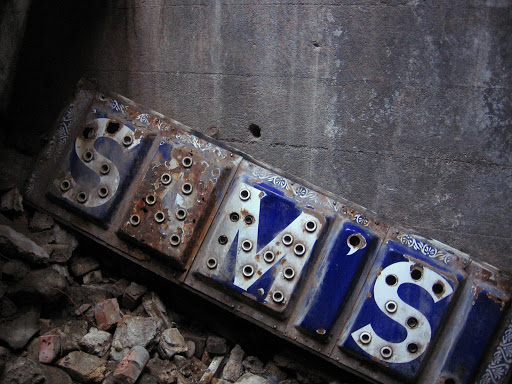
Downtown Seattle of the nineteenth century was built on tidelands, which wreaked havoc with its primitive sewer system. Toilet geysers of raw sewage were a frequent occurrence. When the city was devastated by fire in 1889, officials decided to rebuild at a higher grade to insure what was flushed down would stay down. Trouble was, the process of regrading would take much longer than the local business owners felt like waiting. What eventually happened is the businesses were rebuilt at the original level, then the streets were later raised, making the second floors the new first floors and the original first floors the cellars. For a time shoppers had to climb ladders in order to cross the streets until I-beams were installed across the gaps and sidewalks laid down at the new street level. The original first floors were used for storage and nefarious activity until vermin infestation grew out of hand in the 1900s and the subterranean spaces were closed off. Half a century later these dingy catacombs reopened as a tourist attraction. Unfortunately it turns out underground Seattle is not in fact plagued with sulfurous demons as depicted in the classic Scooby Doo episode, "A Frightened Hound Meets Demons Underground."




20 August 2011
Underground Seattle

04 August 2011
Sxip Shirey at the Cooper Square Hotel
On a rainslick Wednesday evening aural alchemist Sxip Shirey plied his trade in a post-modern penthouse twenty-one stories above the Bowery, the azure glow of the Manhattan skyline serving as an ideal backdrop. While Joe's Pub undergoes renovation, the Cooper Square Hotel kindly lent their upper reaches to the occasional musical outing. On a wooden deck high above the city only a flimsy glass panel prevented guests from being swept overboard by the tempest to the concrete far below. The acrophobes stayed safely indoors.
Revving up the evening was the Raya Brass Band, their jumping brand of Old World Balkan dance music in stark contrast to the ultra-modern space. This hardly concerned the gathering crowd, who encircled the troupe as the percussionist drubbed his tupan and the trumpeter shook his instrument to dislodge more notes out of it.
When Sxip took the stage he hauled aboard various members of the Raya Brass Band and guest vocalist Xavier ("he's like Michael Jackson meets Lionel Richie, only taller.") to compliment his unique bag of bells, whistles and conjurer's tricks. To get the audience in the right frame of mind, he repulsed them with a gratuitous description of blood pudding, a taste for which had acquired on a recent trip to Scotland. He then launched into his usual fare of careening funhouse melody welded to a streetwise stomp. Midway through the show he unveiled the "Sxipenspiel," a conundrum of bicycle bells constructed especially for him by an appreciative Neil Gaiman and Amanda Palmer. Sardined in the small space, the crowd raised wine glasses and cameraphones in celebration and good cheer. A neophyte within earshot attempting to describe Sxip's music to his companion eventually gave up in defeat, surmising "the English language doesn't contain the words for it."
The Chelsea Hotel soon may die a gruesome death. CBGB was dismantled and chucked in the dustbin. New York City had better cling to Sxip Shirey's pleated trouserleg while it can before he is lured away by the dubious temptations of European cuisine.


The Raya Brass Band:
Greg Squared: Reeds
Ben Syversen: Trumpet
Don Godwin: Tuba
EJ Fry: Tupan
Matthew Fass: Accordion
Xavier: Vocals
Sxip Shirey: A chest full of toys
28 July 2011
Existential Dentistry
And that reminds me of the time I nearly cracked the secret of the universe while hallucinating in a dentist's chair. I wasn't there for a serious operation, just a filling that needed to be replaced. After strapping the mask over my nose that would pipe in the nitrous oxide, the dentist courteously explained in some detail what he intended to do, but all I heard was the song playing behind him. The last fairly lucid thought I had was "I didn't know Hendrix did a cover of 'Like a Rolling Stone'..." then I climbed into my bathysphere and descended into the roiling wet clouds, where oddly-shaped bubble creatures floated past, peering curiously at me through a porthole in the hull of my craft.
As the procedure commenced it occurred to me that this particular dentist's voice sounded exactly like that of every other dentist I've had occasion to lean back for. Sure, one might expect the terminology to be similar, but these were even the same mumbled asides, even the same random off-key hummings. I've had several dentists over the years of varying ages in different parts of the country. Yet at this moment they were all one and the same. A dentist archetype. The conversation between him and his assistant was identical to every conversation between every dentist and assistant that has ever taken place. Fragments of dialogue wafted into my ear, each triggering bouts of deja vu. A tricky procedure described as "heroic." A gruesome hatchet injury once encountered in dental school. I could even picture the setting, a cabin stocked with lumber somewhere up north. I've heard this dialogue all before.
I then understood that the Dental Experience is something recorded on a tape and replayed every time the patient reclines in the dentist's chair. There is nothing to fear, the hypnotic tape loop reassures me, because everything is familiar. This is all routine and your well-being is in good hands. You've been here before and you will be here again.
And this led me to reflect on the nature of control. Clearly I was not the one in control of this situation. I willingly handed over the reins fifteen minutes ago (or was it three hours?) when I stepped into this office. The dentist could, on a whim, swing a sledgehammer at my jaw and there was little I could do about it. In this impaired state of mind I might not even recognize that as something I would wish to avoid happening. I pondered what a powerful worldly figure would do in my place. How would Charles Foster Kane react to placing his fate in another's hands? Would he simply not let himself be put in this situation? Perhaps Charles Foster Kane would sooner have a mouthful of rotting teeth than entrust his safety to another.
Then, like a camera filming itself, I thought of myself sitting there trying to make sense of everything. Consciousness is a detective, I realized, eternally puzzling over what is occurring, attempting to make sense of its environment, to piece together meaning out of the disparate clues it finds. But a detective is also a nuisance, a monkeywrench in the machinery. In order to pull off any sort of repair work or self-maintenance such as this, a greater mechanism would have to decoy the detective long enough to work unobstructed, to prevent it from meddling. And that's exactly what the purpose of the nitrous oxide is, a wild goose chase to distract my thoughts from what is really going on. I've voluntarily come in and placed myself completely at the mercy of the dentist. Or did I? Certainly he is functioning under the same principle. Perhaps he is merely an instrument of the maintenance department. This whole thing could be taking place under the influence of some kind of metaphysical nitrous oxide.
A distraction, that's all this is. A distraction in the system. Then suddenly I understood everything. With an almost audible click the whole nature of the universe made sense. As if stormclouds were lifted and I could see into the distance in all directions and knew precisely where I was. The face of the clock was fallen away, exposing the tiny mechanical parts underneath. Everything was so simple and so obvious. I nearly motioned for the procedure to be halted. To hell with my teeth, I had seen the truth. I needed to scribble down this vision of clarity before it was obfuscated. I needed to ask for a pen and paper. If only I could remember how to speak.
And then I noticed the music playing was no longer Hendrix. It sounded familiar though. The melody resembled the song "Such Great Heights." Not the original, but it could have been the delicate Iron and Wine version. And then I knew something was wrong. This was not part of the script. That song hadn't even existed the first time I visited the dentist. It would have been impossible to encode into the tape loop. Something must have short-circuited. An interference of signal. The song was a tip-off that the pattern had been broken. The detective in my head bolted upright.
I opened my eyes and realized I was in the same room I had originally entered. I had been sitting there the entire time. I hadn't gone anywhere. Certainly not for a subterranean ride in a bathysphere. The office around me looked unbearably ordinary. The mask was removed. I was handed a complimentary toothbrush and ushered on my way.
Groggily I stumbled outside into the daylight. I crossed the street to the park where some jazz musicians were gathered, hammering away at an obscure Thelonious Monk tune. I sat on a bench while my head slowly cleared and the feeling seeped back into my jaw, trying to make sense of all this, to reconstruct the state of mind that had led to my recent epiphany. I had a notepad in my lap, ready to jot down the faintest hint of the secret, but my mind was a blank. I felt the despair that for a fleeting moment everything made sense and then was spirited away, like a dream whose wispy tendrils eluded my grasp. Like a pearl disappearing into the murky depths of my soup. A tune whose melody I'd forgotten. Hopelessly I put away my empty notepad, the victim of a cruel joke. Why would the universe reveal its secret to me only to snatch it away again? What was the purpose in that?
And then a bird shat on my bag.
27 July 2011
Biff Bam Boom
Kamala Sankaram recently brought her Summer Music Project to The Stone, John Zorn's stomping grounds in a corner of the East Village. Her confessed intention was to challenge herself to write one composition a week and deliver the collected finished products to an audience within a given timeframe. The result was a cross-pollination of genres incorporating Hanna-Barbera sound effects, Bollywood noir, Saturday morning Crest Gel jingles, early Nintendo soundtracks, spaghetti westerns, as well as experiments in chance music and recontextualized noise. Her able-bodied crew kept up with even her most eccentric of ideas. What is especially notable about Kamala's music is its tendency to straddle the divide between experimental and tuneful. In other words, it keeps your brain and your toes simultaneously engaged.


The cast:
Kamala Sankaram (voice, squeezebox, bleeps, bloops)
Pat Muchmore (cello-fiddle, hairstyle)
Ed RosenBerg (duck call, tenor sax)
Jeff Hudgins (tubular bell, alto sax)
Drew Fleming (testosterone box, guitar)
25 July 2011
Incongruity
Dictionary, tell me about incongruity.
incongruity: the quality or state of being incongruous
incongruous: lacking congruity
congruity: the quality or state of being congruent
congruent: congruous
[hurls dictionary out window]
22 July 2011

19 July 2011
Street Mouse

Sad Stuff on the Street appears to have used this photo which I snapped on a Bushwick sidewalk back in May. They titled it "Puma preying on yellow mouse."
Earlier this year I tried to interest them in this ravaged teddy bear but it was considered too gruesome.
16 July 2011
Ghost Train Orchestra
Friday night the Ghost Train Orchestra caused structural damage to the roof of Barbes in Park Slope. Squeezing their crew of nine into a performance space the size of a steamer trunk, the band played a blistering set of tunes from their recent album Hothouse Stomp, prodded by ringleader Brian Carpenter. This meant plenty of Chicago and Harlem-centered big band swing from the twenties by the likes of Hartzell "Tiny" Parham and Fess Williams. Trombone slides and violin bows stabbed manically in all directions. Renowned "washboardiste" Rob Garcia thrashed his instrument within an inch of its life, in conspiracy with the crazed banjo brutality of Brandon Seabrook. Secret weapon Mazz Swift set down her violin at one point and leaned into the microphone for an earthy rendering of their one vocal number, "Gee Baby, Ain't I Good to You." After a brief intermission during which the stunned audience was allowed to sift through the wreckage, the Orchestra returned for a dizzying set of Raymond Scott and John Kirby numbers, an industrial age soundtrack to a demented cartoon that wouldn't stand a chance under Hayes Code scrutiny. Barbes never knew what hit them.


Ghost Train Orchestra:
Brian Carpenter (trumpet, harmonica)
Mazz Swift (violin, vocals)
Andy Laster (alto saxophone)
Petr Cancura (tenor saxophone)
Curtis Hasselbring (trombone)
Ron Caswell (tuba)
Avi Bortnick (guitar)
Joe Fitzgerald (bass)
Rob Garcia (drums, washboard)
10 July 2011
The New York City Marble Cemetery
The New York City Marble Cemetery opened its gates for the public this afternoon, something it only does a few times a year. Also known as the Second Avenue Cemetery, this half-acre of land squeezed between East Village tenements originally opened in 1831 and for much of that century was quite the fashionable place to be buried. Unlike common burial practices, concern for the spread of yellow fever meant the dead were buried deep in vaults of Tuckahoe marble. The grounds are surrounded on three sides by a high wall of rubble while an imposing iron fence separates it from the street.
The cemetery's most prominent member was President James Monroe, who was buried here in 1831, though his remains were later moved elsewhere. Other notable residents include one-time mayor Stephen Allen, financier Moses Taylor, archaeologist John Lloyd Stephens, and a shipping merchant known enigmatically as Preserved Fish.
The cemetery was added to the National Register of Historic Places in 1980.


This monument to archaeologist John Lloyd Stephens incorporates Mayan glyphs into the design.


Possibly the greatest name in the history of New York City, Mangle M. Quackenbos.


01 July 2011
Sweet Soubrette

Sweet Soubrette beguiles the Parkside Lounge with songs about "Darwinism, public baths, giant insects, and famous dead women."
17 June 2011
The East River Ferry
This week New York launched a new ferry service along the East River, pingponging between the Manhattan and Brooklyn banks from 34th to Wall Street. All rides are free during the two-week trial run, after which a one-way trip will relieve the seafarer of four greenbacks. The ferry, a smaller, cleaner version of its elder Staten Island brethren, offers a leisurely cruise down the east side of Manhattan island, passing Hunter's Point, the Williamsburg waterfront, the Domino Sugar Factory, Empire Fulton Park, underneath three of our finest bridges, and finally coming to berth at the South Street Seaport. As I understand it the route will at times be extended to Governor's Island.
As far as the competitive mode of transportation which the city predicts, I don't see much practical value. The journey is entirely too slow to compete with the subway. And unless you happen to live near one of the several piers at which the boat stops, a ride on a bus or train will be necessary to reach the waterfront anyway. Once you've subjected yourself to the brutal indignities of the subway, I figure you might as well ride it out to your destination. The city claims ridership is higher than expected the first week, but of course a. it's currently free, and b. the novelty of seeing what it's all about is still fresh. Nearly everyone aboard when I rode was armed with a camera and clearly not commuting to work.
The ferry's fate is yet to be determined, and with any luck my doubts will be proven groundless. Anything which threatens to harpoon the MTA's stranglehold on the public has my support. Meanwhile here are a few sightings from my voyage.

Awaiting the ferry on an overcast morning.

The pier at 34th Street.

Our steadfast captain at the helm.

Hunter's Point.

The Greenpoint pier and eager gathering.

A backwards glance at Manhattan.

The Williamsburg pier.

The Domino Sugar Factory of South Williamsburg.

Beneath the Williamsburg Bridge.

The Manhattan end of the Williamsburg Bridge.

The Manhattan Bridge leading to DUMBO.