
The Longfellow (aka Salt-and-Pepper) Bridge spanning the Charles River.

One of the salt shakers.

The Boston skyline from mid-bridge.

The gusting winds in Kendall Square have been known to sweep unsuspecting pedestrians off their feet, often with vaudevillian results.

The Ray and Maria Stata Center, designed by Frank Gehry. Yes, it was apparently intended to look like it was left in the microwave too long.
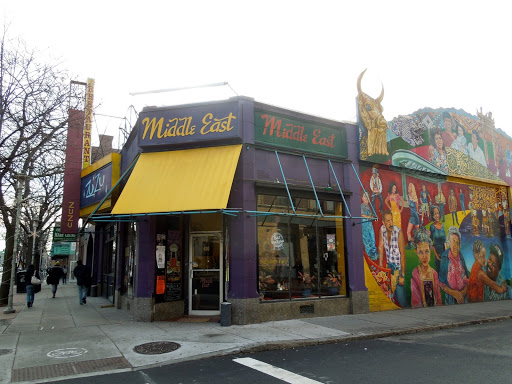
The Middle East in Central Square. Musical legends were born on its multiple stages. Also the beef kebab is highly recommended.

Cambridge City Hall.

The People's Republik, a Communist-themed pub. Inside, a bomb and giant military boot hang overhead.

At the Harvard Bookstore. No point in asking which authors tend to get shoplifted the most.

A Hungarian walks into a tobacconists...


The Harvard Square Pit, where punks and jugbands congregate during the warmer seasons.

Down in the Harvard Square station at midnight.

The Brattle Theatre, a cinephile's paradise. An ideal place to catch Marx Brothers comedies.
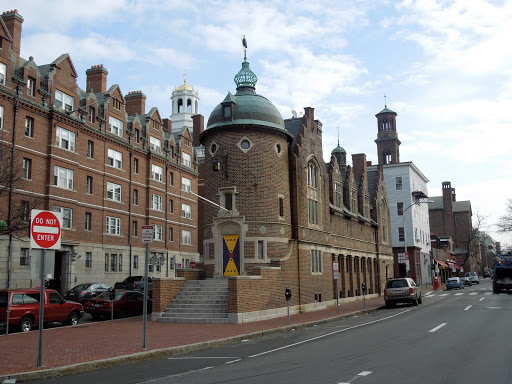
The Harvard Lampoon Castle. Not many buildings can claim to wear a Prussian pickelhaube.

The Weld Boathouse.

On the bank of the Charles River.

The John W. Weeks footbridge. Any self-respecting movie set at Harvard probably features this as its opening shot.

The First Parish Church, where I saw David Foster Wallace read from his book Oblivion soon after it was released.

Inside the Border Cafe, awaiting my lunch.

The wall outside the Harvard Loews Theater.

Harvard Epworth United Methodist Church.

"Gift of the Wind" kinetic sculpture in Porter Square.

The Rosebud Diner in Davis Square, where I was once admonished by a waitress for not finishing my clam chowder.

The Davis Square compass rose stone, a popular late night passing-out spot.

Davis Square.

Two of the "Ten Figures" sculptures that populate the square. The Somerville Theatre, behind them, is known for unique events such as showing silent films with live accompaniment by the Alloy Orchestra. It also houses a branch of the Museum of Bad Art.

A stone field house in Powderhouse Square, built during the Great Depression.

Originally a windmill, the Old Powder House in Nathan Tufts Park was used to store gunpowder during the Revolutionary War. Later it was used for storing pickles.
14 January 2012
Cambridge & Somerville

13 January 2012
Boston, Part II
Picking up where we left off...

44A Charles Street is the former residence of Mary Sullivan, the Boston Strangler's final victim. Also, the Paramount makes a damn fine breakfast.

William Dean Howells, Louisa May Alcott, and John Kerry are a few of the luminaries who at some point claimed occupancy among the Greek Revival houses of Louisburg Square.

9 Willow Street was once the residence of tormented poet Sylvia Plath.

In Beacon Hill the cellar gnomes have their own entrance.

Steve McQueen's abode in The Thomas Crowne Affair. The Federal-style mansion was originally designed for Congressman Harrison Gray Otis in 1800 by the esteemed architect Charles Bulfinch (whom one could be forgiven for assuming designed most of Boston).

My idea of what a market should look like.

Central wharf overlooking the Boston Harbor.

I can't decide which angle I like better.

The Custom House Tower.

The historic Omni Parker House. Home to the Saturday Night Club, which consisted of literary heavyweights Emerson, Longfellow, and frequent guest Charles Dickens. Ho Chi Minh and Malcolm X were both spotted working in the kitchen in their formative years. The hotel is also the location of numerous reported ghost sightings.

The John Adams Courthouse, discreetly hidden behind the less ornate Center Plaza.

The Granary Burying Ground.

Paul Revere rests here. You may have heard of him.

Ice skaters in the Boston Common.

The John Hancock Tower rising in the distance. When completed in 1976 there was a minor issue of windowpanes dropping off during strong winds, which proved unsatisfactory to pedestrians below.
Next, we cross the river into Cambridge...
Boston, Part I
For six years in the aughts Boston was the city I called home. Since I wasn't yet the shutterbug I've since become, however, my stay was never properly documented on film. Early this week on a whim I decided to correct this in a frenzied two-day kamikaze attack. Here are the results.

In Copley Square. Trinity Church, Hancock Tower, and an audacious bird who wanted in on the action.

The First Church of Christ Science, otherwise known as the Mother Church.

The Prudential Center, the R2-D2 Building, and the Christian Science Administration Building, respectively.

Abigail Adams stands guard in the Commonwealth Avenue Mall.

In the early sixties a vibrant section of town called Scollay Square was bulldozed to make way for the monstrous Boston City Hall. Brutalist architecture is brutal.

This used to be a hideous snarl of rusting elevated expressway. After years of unsightly construction and structural mishap the roads have all been diverted underground, freeing up the grounds for a serene public space.

The Paul Revere Mall leading to the Old North Church. "One if by land..."

Copp's Hill Burying Ground, the second oldest cemetery in Boston, makes an appearance in H.P. Lovecraft's short story "Pickman's Model."

The Custom House Tower at dusk. Until 1964 it was the tallest structure in the city. And is still one of the grandest.

Christopher Columbus Waterfront Park.

Joe's on the Waterfront.


Boston Harbor by night.

The Massachusetts State House, sitting majestically atop Beacon Hill.
To be continued...
12 January 2012
Boston Public Garden
The Boston Public Garden was established in 1837 in the heart of downtown and features as a setting in the stories The Bell Jar, The Trumpet of the Swan, and Make Way for Ducklings. The pond in the center is famous for the swan boats that carry riders during the warmer seasons, though there were few to be seen on a blustery day in January.


A Japanese lantern.

The footbridge.


The trumpet of the swan.

Bronze equestrian statue of George Washington.


A fountain, on holiday for the winter.

You've heard of a one-man band. This is a no-man band.

Historian and clergyman Edward Everett Hale looking properly dignified.

After an early morning snowfall.

Make Way For Ducklings.


